WHY WE NEED A STRONG CIVIL JUSTICE SYSTEM
Martin’s Story:
My name is Donna D. Harnett and I am the mother of four boys. My eldest son Martin was severely disabled. He passed away on Jan. 28, 2010, at the age of 14.
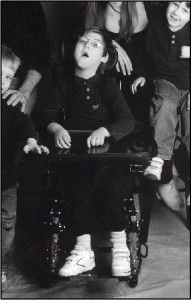
I mention my other children because you should know that not a day goes by when I look at them as they play and think about what Martin’s life could have been. Martin’s life was destroyed the moment it began as a result of medical negligence.
The doctor who was involved in my delivery was a teaching physician at a prominent hospital in Cook County. My case against him was not the first; there were several others with a similarly disastrous outcome. Unfortunately, I was not aware of the cases at the time. Despite the other lawsuits, the doctor retained his license to practice. At the time of my delivery, he was listed on the Illinois Department of Professional Regulation website as never having been disciplined.
Martin’s disabilities were severe. He was a quadriplegic. His movements were limited to turning his head slightly in each direction, moving his arms a few inches in a sweeping manner, and lifting his right leg a few inches. He didn’t walk. He was unable to talk, although he did make a few noises that I could interpret as words. He wore diapers. He was able to eat by mouth until a surgery for his stomach. Then, he lost that skill and was fed through a button in his stomach. He was completely dependent on others for all of his care.
I filed a lawsuit against all of those involved in my prenatal and delivery care, and I settled out of court before trial. Some people think settling a medical malpractice lawsuit or receiving a jury award is comparable to winning the lottery. They obviously have no concept of the suffering my son went through.
Let me tell you about this lawsuit lottery winner’s life. He had at least one doctor appointment per week. He received physical therapy, not only at home but also at school every week. I was called by the school at least every two weeks to come and comfort him, because their only alternative was to call for an ambulance. Obviously, I had to drop everything and tend to his needs. He was unable to socialize with others. He couldn’t run or play with his brothers. His existence consisted of laying or sitting in a wheelchair, completely helpless.
We were at the emergency room at least once a month, because something as simple as a cold would land him in the intensive care unit at the hospital. Because we were there so much, we were recognized by the majority of the staff as we walked through the halls.
Our lives were far from typical. The money from the settlement was used to restore my son’s life to some normalcy, to give him a quality of life that he would not have had without it, and the money was used for that purpose alone. As he grew and got older, his needs became more expensive.
When my son was little, I was able to lift him in and out of my little car and put his stroller in the trunk. Then we used an adapted van with a wheelchair lift that cost $57,000. That van was purchased using the money from the settlement. It was the only way that we could travel anywhere.
If we wanted to go to the zoo, a park, a museum or anywhere else as a family, we usually needed to have help. Someone had to push Martin’s wheelchair so I could hold the hands of my other children. Because there was no one else in our lives, I had to pay someone to help. That money came from the settlement. Without it, we would have been prisoners in our home, unable to go anywhere with Martin.
We lived in a first floor apartment. Every day, I’d carry my son up and down a flight of stairs in my arms to his wheelchair. He weighed 60 lbs. The bathroom was small and my son couldn’t fit in the bathtub because I could barely bend his legs. Every day, I was amazed I could lift him up and over the edge of the tub while on my knees. We moved to another home that cost approximately $100,000 to make the first floor accessible for Martin – and that didn’t include the purchase price of the home.
The money to buy the home and make it accessible came from the settlement. Without that money, I would have been forced to think about the possibility of sending my son to an institution where he would grow up in the company of strangers. The settlement made it possible for my son to stay at home with his siblings and myself, who loved him very much.
I would give it all back if I could just have had my son as he should have been.